“Across industries, between companies, and over time, wellbeing is proving to be an ever more important predictor of company performance. Organizations seeking to be successful in the new world of work would be wise to take note”
That’s the conclusion of the University of Oxford’s Wellbeing Research Centre.
There is a strong connection between employee wellbeing and firm performance.
In other words, strong financial performance is closely related to a workforce that feels engaged, happy, and healthy.
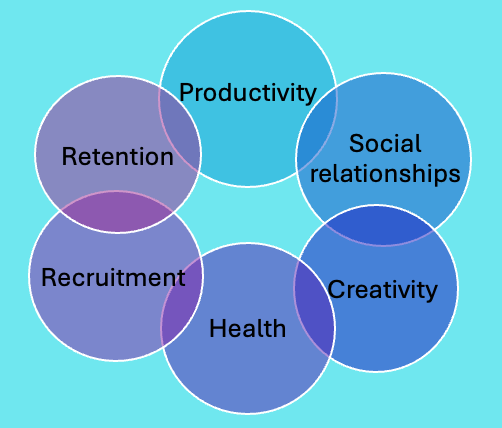
Pathways from wellbeing to financial performance:
(1) productivity – there’s a statistically significant correlation between job satisfaction and productivity (productivity often shows up in increased quality of work output),
(2) social relationships – employees who are happier develop more relationships, higher capacity for cooperation and are even better negotiators,
(3) creativity – positive mood enhances creativity, including problem solving,
(4) health – happy people have less pain, live longer, better cardiovascular and immune function; conversely poor health (mental or physical) creates absenteeism and presentism (working while sick) with lowered productivity,
(5) recruitment – employees value social responsibility of organizations and will give up a wage premium for it because they count it as a marker of wellbeing, and
(6) retention – employees with high levels of job satisfaction stay longer and wellbeing initiatives can create job satisfaction
With 6 factors contributing to wellbeing, which ones can you pull to increase engagement and performance?
 WorkLore
Leave a comment