“AI-this” and “AI-that” can be a bit overwhelming at times.
Sometimes when that happens, I think back to more analog times, a benefit of having lived long enough to be comfortable in both worlds.
In this case, I thought about how technology changes.
Sometimes when I talk about technology with students. I hold up a pencil and tell them it is a kind of technology too – it is a tool plus a system (writing) that helps human beings accomplish what they want.
They usually aren’t convinced it’s a technology because to them technology involves electronics and fancy, expensive gadgets. But then we talk some more about the core of technology, which is as an enabler and enhancer of human ability and they start to get it. I talk about how snowmobiles changed Arctic hunter activity extending their ability to hunt. How a process can also be a technology, like how Ford’s factory model, which made it easier to produce automobiles.
It takes a while, but they start to see it.
This became relevant as I happened across a quote about employer – employee relationships from decades before AI:
“At the foundation of any business transaction is the premise of a fair deal.
In complex organizational relationships, it is all too easy to lose sight [of this]. On the surface, the employer / employee relationship is a fair deal wherein the employer’s money is traded for the employee’s time and talent. The deeper reality, however, is that the employer is actually trading resources for a set of desirable results, which the employee is expected to deliver.
As many observers have noted, our knowledge-based society requires creativity, commitment to results, judgment, and discretion from its workforce. The terms of the employment transaction become fuzzier as the need for judgment and description on-the-job becomes greater.”
Klatt, Murphy, Irvine, 1998
So what happens when the work is done by a machine, an artificial intelligence? How does that change the notion of the fair deal? How does it change the employer-employee relationship, particularly as Klatt, Murphy and Irvine note for knowledge-based workforces?
I ask these questions because what stands out to me in this quote is the focus on judgment. AI’s notorious hallucinations or its inability to detect context in certain situations speaks to an uneven application of judgement. And the doubling down that we have sometimes seen from AI when it is wrong, can create even more problems.
And true, human beings sometimes display bad judgement. No argument there. But most of the time, human judgement is still required to oversee that work of AI. The human-in-the-loop of agentic AI, for example.
But AI is starting to change the nature of that knowledge work, including judgement, as well.
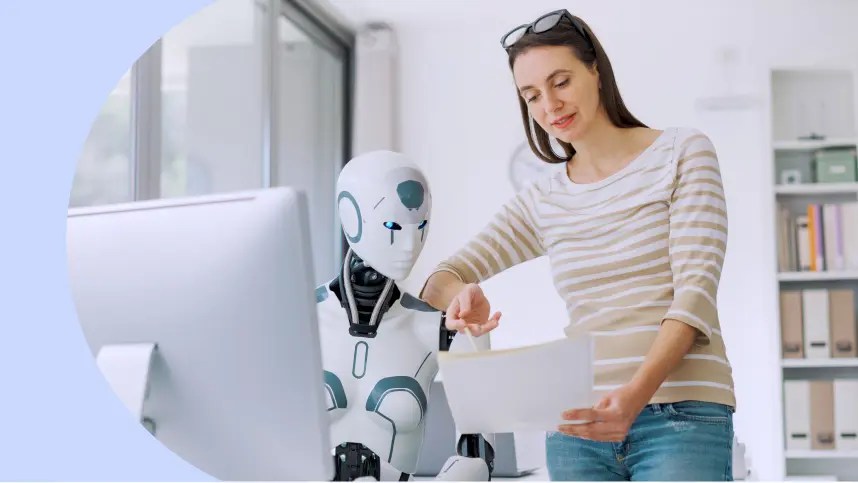
I heard someone speaking about employees and AI, suggesting that it might be useful to think about AI as a junior employee (needing oversight).
But how far do we take that analogy? Is it just about the work, or is it about the relationship as well?
Tbh, I don’t think it is about the relationship, but it is an interesting thought experiment.
What would HR for AI look like? Recruitment and selection? Performance management? Succession planning? Learning and development?
 WorkLore
Leave a comment